
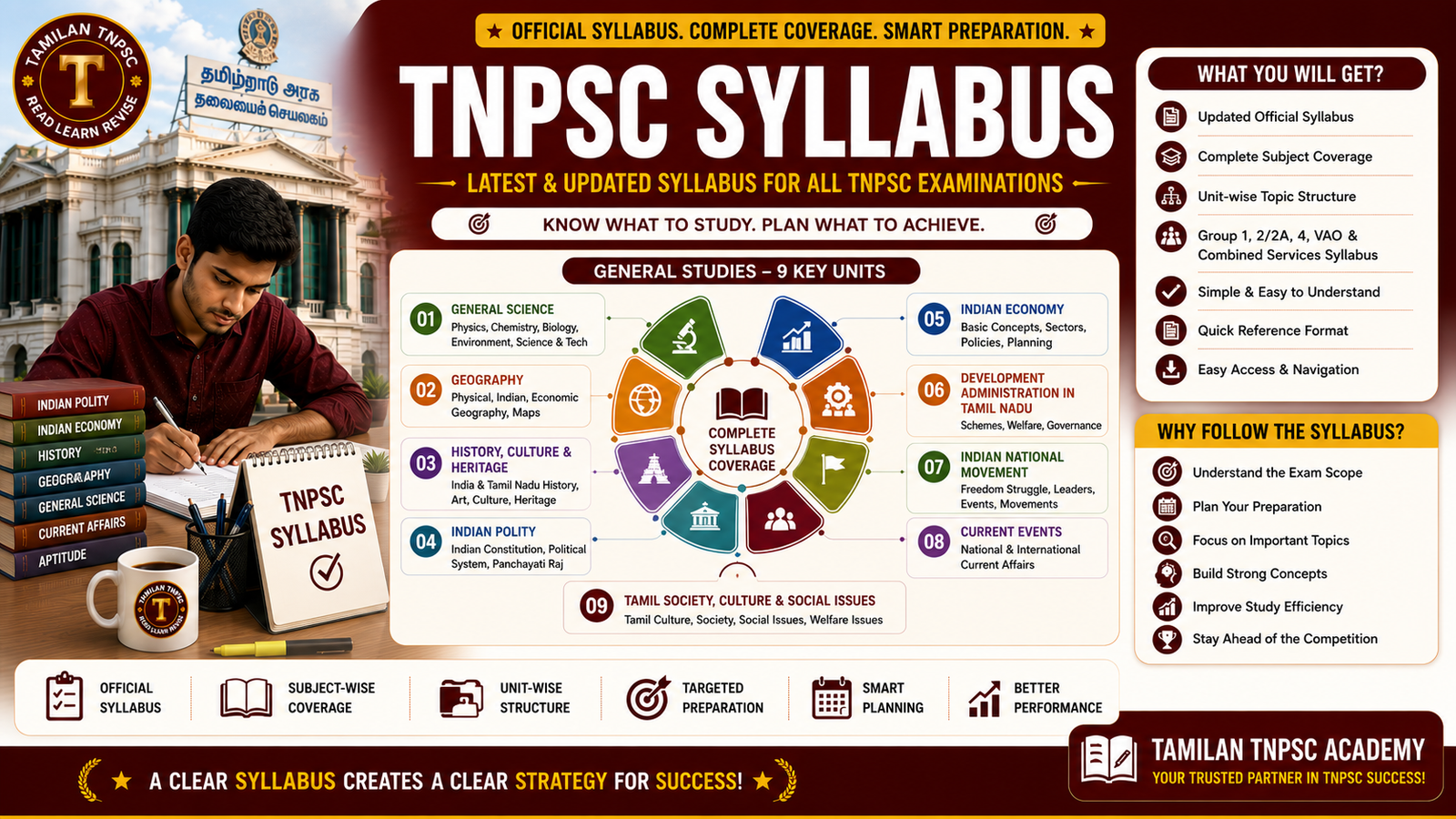
Prepare smart and stay ahead in your TNPSC 2026 journey with the latest and updated syllabus for Group 1, Group 2/2A, and Group 4 Prelims and Mains — all in one place. At TAMILAN TNPSC ACADEMY, we provide the complete TNPSC syllabus in both Tamil and English, to help aspirants understand exactly what to study and how to plan effectively.
This page gives you official syllabus PDFs, structured topic-wise, aligned with the latest TNPSC exam pattern and trends.
| Exam | Language | Download Link |
|---|---|---|
| TNPSC Group 1 Prelims Syllabus 2026 | Tamil | Download PDF |
| TNPSC Group 1 Prelims Syllabus 2026 | English | Download PDF |
| TNPSC Group 1 Mains Syllabus 2026 | Tamil | Download PDF |
| TNPSC Group 1 Mains Syllabus 2026 | English | Download PDF |
| TNPSC Group 2/2A Prelims Syllabus 2026 | Tamil | Download PDF |
| TNPSC Group 2/2A Prelims Syllabus 2026 | English | Download PDF |
| TNPSC Group 2/2A Mains Syllabus 2026 | Tamil | Download PDF |
| TNPSC Group 2/2A Mains Syllabus 2026 | English | Download PDF |
| TNPSC Group 4 Syllabus 2026 | Tamil | Download PDF |
| TNPSC Group 4 Syllabus 2026 | English | Download PDF |
Understanding the TNPSC syllabus is the foundation of success in Group 1, Group 2/2A, and Group 4 exams.
Unit I: General Science (10 Questions) Scientific knowledge and scientific temper – Power of reasoning – Rote learning vs conceptual learning – Science as a tool to understand the past, present, and future; Nature of universe – General scientific laws – Mechanics – Properties of matter, force, motion, and energy – Everyday application of the basic principles of mechanics, electricity and magnetism, light, sound, heat, nuclear physics, laser, electronics, and communications; Elements and compounds, acids, bases, salts, petroleum products, fertilizers, pesticides; Main concepts of life science, classification of living organisms, evolution, genetics, physiology, nutrition, health and hygiene, human diseases; Environment and ecology; Latest inventions in science and technology; Current affairs.
Unit II: Geography of India (10 Questions) Location – Physical features – Monsoon, rainfall, weather and climate – Water resources – Rivers in India – Soil, Minerals and Natural Resources – Forest and Wildlife – Agricultural pattern; Transport – Communication; Social Geography – Population density and distribution – Racial, linguistic groups and major tribes; Natural calamity – Disaster management – Environmental pollution – Reasons and preventive measures – Climate change – Green energy; Geographical landmarks; Current affairs.
Unit III: History, Culture of India, and Indian National Movement (25 Questions) Indus Valley Civilization – Guptas, Delhi Sultans, Mughals, and Marathas – Age of Vijayanagaram and Bahmani Kingdoms – South Indian History; Change and continuity in the socio-cultural history of India; National Renaissance – Early uprising against British rule – Indian National Congress – Emergence of leaders – B.R.Ambedkar, Bhagat Singh, Bharathiar, V.O.Chidambaranar, Jawaharlal Nehru, Kamarajar, Mahatma Gandhi, Maulana Abul Kalam Azad, Thanthai Periyar, Rajaji, Subash Chandra Bose, Rabindranath Tagore, and others; Different modes of agitation: Growth of Satyagraha and Militant Movements; Communalism and Partition; Characteristics of Indian Culture, Unity in Diversity – Race, Language, Custom; India as a Secular State, Social Harmony; Prominent personalities in various spheres – Arts, Science, Literature and Philosophy; National symbols – Eminent personalities and places in news – Sports – Books and Authors; Current affairs.
Unit IV: Indian Polity (40 Questions) Constitution of India – Preamble to the Constitution – Salient features of the Constitution – Union, State and Union Territory – Citizenship, Fundamental Rights, Fundamental Duties, Directive Principles of State Policy – Union Executive, Union Legislature – State Executive, State Legislature – Local Governments, Panchayat Raj – Spirit of federalism: Centre – State relationships – Election – Judiciary in India – Rule of Law – Corruption in public life – Anti-corruption measures – Lokpal and Lok Ayukta – Right to Information – Empowerment of Women – Consumer Protection Forums, Human Rights Charter; Political parties and political system in India; Current affairs.
Unit V: Indian Economy and Development Administration in Tamil Nadu (50 Questions) Nature of Indian Economy – Five-year plan models – an assessment – Planning Commission and Niti Aayog; Sources of revenue – Reserve Bank of India – Fiscal Policy and Monetary Policy – Finance Commission – Resource sharing between Union and State Governments – Goods and Services Tax; Structure of Indian economy and employment generation, Land Reforms and Agriculture – Application of Science and Technology in Agriculture – Industrial growth – Rural welfare oriented programmes – Social problems – Population, Education, Health, Employment, Poverty; Human Development Indicators in Tamil Nadu and a comparative assessment across the Country – Impact of social reform movements in the socio-economic development of Tamil Nadu – Political parties and welfare schemes for various sections of people – Rationale behind the reservation policy, and access to the social resources – Economic trends in Tamil Nadu – Role and impact of social welfare schemes in the socio-economic development of Tamil Nadu – Social justice and social harmony as the cornerstones of socio-economic development; Education and health systems in Tamil Nadu; Geography of Tamil Nadu and its impact on economic growth; Achievements of Tamil Nadu in various fields; e-Governance in Tamil Nadu; Public awareness and General administration – Welfare oriented Government schemes and their utility, Problems in public delivery systems; Current socio-economic issues; Current affairs.
Unit VI: History, Culture, Heritage, and Socio-Political Movements in Tamil Nadu (40 Questions) History of Tamil Society, related archaeological discoveries, Tamil literature from Sangam age till contemporary times; Thirukkural – Significance as a secular literature – Relevance to everyday life, Impact of Thirukkural on humanity, Thirukkural and universal values – Relevance to Socio-politicoeconomic affairs, Philosophical content in Thirukkural; Role of Tamil Nadu in freedom struggle – Early agitations against British Rule – Role of women in freedom struggle; Evolution of 19th and 20th century socio-political movements in Tamil Nadu – Justice Party, Growth of Rationalism – Self Respect Movement, Dravidian Movement, and principles underlying both these movements; Contributions of Thanthai Periyar and Perarignar Anna.
PART – B Aptitude and Mental Ability (SSLC Standard – 25 Questions)
Unit I: Aptitude (15 Questions) Simplification – Percentage – Highest Common Factor (HCF) – Lowest Common Multiple (LCM) – Ratio and Proportion – Simple interest – Compound interest – Area – Volume – Time and Work
Unit II: Reasoning (10 Questions) Logical reasoning – Puzzles – Dice – Visual reasoning – Alpha numeric reasoning – Number series
Unit I: General Science (5 Questions) Scientific knowledge and scientific temper – Power of reasoning – Rote learning vs conceptual learning – Science as a tool to understand the past, present, and future; Nature of universe – General scientific laws – Mechanics – Properties of matter, force, motion, and energy – Everyday application of the basic principles of mechanics, electricity and magnetism, light, sound, heat, nuclear physics, laser, electronics, and communications; Elements and compounds, acids, bases, salts, petroleum products, fertilizers, pesticides; Main concepts of life science, classification of living organisms, evolution, genetics, physiology, nutrition, health and hygiene, human diseases; Environment and ecology; Latest inventions in science and technology; Current affairs.
Unit II: Geography of India (5 Questions) Location – Physical features – Monsoon, rainfall, weather and climate – Water resources – Rivers in India – Soil, Minerals and Natural Resources – Forest and Wildlife – Agricultural pattern; Transport – Communication; Social Geography – Population density and distribution – Racial, linguistic groups and major tribes; Natural calamity – Disaster management; Environmental pollution – Reasons and preventive measures – Climate change – Green energy; Geographical landmarks; Current affairs.
Unit III: History, Culture of India, and Indian National Movement (10 Questions) Indus Valley Civilization – Guptas, Delhi Sultans, Mughals, and Marathas – Age of Vijayanagaram and Bahmani Kingdoms – South Indian History; National Renaissance – Early uprising against British rule – Indian National Congress – Emergence of leaders – B.R.Ambedkar, Bhagat Singh, Bharathiar, V.O.Chidambaranar, Jawaharlal Nehru, Kamarajar, Mahatma Gandhi, Maulana Abul Kalam Azad, Thanthai Periyar, Rajaji, Subash Chandra Bose, Rabindranath Tagore, and others; Different modes of agitation: Growth of Satyagraha and Militant Movements; Communalism and Partition; Change and continuity in the socio-cultural history of India; Characteristics of Indian Culture, Unity in Diversity – Race, Language, Custom; India as a secular state, Social harmony; Prominent personalities in various spheres – Arts, Science, Literature and Philosophy.
Unit IV: Indian Polity (15 Questions) Constitution of India – Preamble to the Constitution – Salient features of the Constitution – Union, State and Union Territory – Citizenship, Fundamental Rights, Fundamental Duties, Directive Principles of State Policy – Union Executive, Union Legislature – State Executive, State Legislature – Local Governments, Panchayat Raj – Spirit of federalism: Centre – State relationships – Election – Judiciary in India – Rule of Law – Corruption in public life – Anti-corruption measures – Lokpal and Lok Ayukta – Right to Information – Empowerment of Women – Consumer Protection Forums, Human Rights Charter; Political parties and political system in India; Current affairs.
Unit V: Indian Economy and Development Administration in Tamil Nadu (20 Questions) Nature of Indian Economy – Five-year plan models – an assessment – Planning Commission and Niti Aayog; Sources of revenue – Reserve Bank of India – Fiscal Policy and Monetary Policy – Finance Commission – Resource sharing between Union and State Governments – Goods and Services Tax; Structure of Indian Economy and Employment Generation, Land Reforms and Agriculture – Application of Science and Technology in Agriculture – Industrial growth – Rural welfare oriented programmes – Social problems – Population, Education, Health, Employment, Poverty; Human Development Indicators in Tamil Nadu and a comparative assessment across the Country – Impact of social reform movements in the socio-economic development of Tamil Nadu – Political parties, and welfare schemes for various sections of people – Rationale behind the reservation policy, and access to the social resources – Economic trends in Tamil Nadu – Role and impact of social welfare schemes in the socio-economic development of Tamil Nadu – Social Justice and social harmony as the cornerstones of socio-economic development; Education and health systems in Tamil Nadu; Geography of Tamil Nadu and its impact on economic growth; Achievements of Tamil Nadu in various fields; e-Governance in Tamil Nadu; Public awareness and General administration – Welfare oriented Government schemes and their utility, Problems in public delivery systems; Current socio-economic issues; Current affairs.
Unit VI: History, Culture, Heritage, and Socio-Political Movements in Tamil Nadu (20 Questions) History of Tamil Society, related archaeological discoveries, Tamil literature from Sangam age till contemporary times – Thirukkural – Significance as a secular literature – Relevance to everyday life, Impact of Thirukkural on humanity, Thirukkural and universal values – Relevance to Socio-politicoeconomic affairs, Philosophical content in Thirukkural; Role of Tamil Nadu in freedom struggle – Early agitations against British Rule – Role of women in freedom struggle; Evolution of 19th and 20th century socio-political movements in Tamil Nadu – Justice Party, Growth of Rationalism – Self Respect Movement, Dravidian Movement, and principles underlying both these movements; Contributions of Thanthai Periyar and Perarignar Anna.
PART – B: Aptitude and Mental Ability (SSLC Standard – 25 Questions)
Unit I: Aptitude (15 Questions) Simplification – Percentage – Highest Common Factor (HCF) – Lowest Common Multiple (LCM) – Ratio and Proportion – Simple interest – Compound interest – Area – Volume – Time and Work.
Unit II: Reasoning (10 Questions) Logical reasoning – Puzzles – Dice – Visual reasoning – Alpha numeric reasoning – Number series. General Tamil (இலக்கணம், சொல்லகராதி, எழுதும் திறன், கலைச்சொற்கள், வாசித்தல் – புரிந்து கொள்ளும் திறன், எளிய மொழிபெயர்ப்பு, இலக்கியம், தமிழ் அறிஞர்களும், தமிழ்த்தொண்டும்), General English (Grammar, Vocabulary, Writing Skills, Technical Terms, Reading Comprehension, Translation, Literary Works – Poems, Prose)
Unit I: General Science (5 Questions) Nature of Universe – Measurement of physical quantities – General scientific laws in motion – force, pressure, and energy – Everyday application of the basic principles of mechanics, electricity, magnetism, light, sound, heat, and nuclear physics in our daily life; Elements and compounds, acids, bases, salts, petroleum products, fertilizers, pesticides, metallurgy, and food adulterants; main concepts of life science, classification of living organisms, evolution, genetics, physiology, nutrition, health and hygiene, human diseases; Environmental science; Latest inventions in science and technology; Current affairs.
Unit II: Geography (5 Questions) Earth location – Physical features – Monsoon, rainfall, weather, and climate – Water resources – Rivers – Soil, Minerals, and Natural resources – Forest and Wildlife – Agriculture pattern; Transport – Communication; Population density and distribution in Tamil Nadu and India; Calamities – Disaster management – Environment – Climate change; Geographical landmarks; Current affairs.
Unit III: History, Culture of India, and Indian National Movement (10 Questions) Indus Valley Civilization – Guptas, Delhi Sultans, Mughals, and Marathas – South Indian History; National Renaissance – Early uprising against British Rule – Indian National Congress – Emergence of Leaders – B.R.Ambedkar, Bhagat Singh, Bharathiar, V.O.Chidambaranar, Thanthai Periyar, Jawaharlal Nehru, Rabindranath Tagore, Kamarajar, Mahatma Gandhi, Maulana Abul Kalam Azad, Rajaji, Subhash Chandra Bose, Muthulaksmi Ammaiyar, Muvalur Ramamirtham, and other National Leaders; Different modes of agitation of Tamil Nadu and movements; Characteristics of Indian Culture, Unity in Diversity – Race, Language, Custom; India as a secular state.
Unit IV: Indian Polity (15 Questions) Constitution of India – Preamble to the Constitution – Salient features of the Constitution – Union, State, and Union Territory; Citizenship, Fundamental Rights, Fundamental Duties, Directive Principles of State Policy; Union Executive, Union Legislature – State Executive, State Legislature – Local Governments, Panchayat Raj; Spirit of federalism: Centre – State relationships; Election – Judiciary in India – Rule of Law; Corruption in public life – Anti-Corruption measures – Lokpal and Lokayukta – Right to Information – Empowerment of Women – Consumer Protection Forums – Human Rights Charter; Political parties and political system in Tamil Nadu and India; Current affairs.
Unit V: Indian Economy and Development Administration in Tamil Nadu (20 Questions) Nature of Indian economy – Five-year plan models – an assessment – Planning Commission and Niti Aayog; Sources of revenue – Reserve Bank of India – Finance Commission – Resource sharing between Union and State Governments – Goods and Services Tax; Economic trends – Employment generation, Land reforms and Agriculture – Application of Science and Technology in Agriculture; Industrial growth – Rural Welfare oriented programmes – Social problems – Population, Education, Health, Employment, Poverty; Social Justice and Social Harmony as the cornerstones of socioeconomic development; Education and Health systems in Tamil Nadu; Geography of Tamil Nadu and its impact on economic growth; Welfare schemes of Government; Current socio-economic issues; Current affairs.
Unit VI: History, Culture, Heritage, and Socio-Political Movements of Tamil Nadu (20 Questions) History of Tamil Society, related archaeological discoveries – Tamil Literature from Sangam age till contemporary times; Thirukkural – Significance as a Secular Literature – Relevance to everyday life – Impact of Thirukkural on Humanity – Thirukkural and Universal Values – Relevance to Sociopolitico-economic affairs – Philosophical content in Thirukkural; Role of Tamil Nadu in freedom struggle – Early agitations against British Rule – Role of women in freedom struggle; Various Social reformers, Social reform movements and Social transformation of Tamil Nadu.
Unit I: Aptitude (15 Questions) Simplification – Percentage – Highest Common Factor (HCF) – Lowest Common Multiple (LCM) – Ratio and Proportion – Simple interest – Compound interest – Area – Volume – Time and Work.
Unit II: Reasoning (10 Questions) Logical reasoning – Puzzles – Dice – Visual reasoning – Alpha numeric reasoning – Number series. General Tamil (இலக்கணம், சொல்லகராதி, எழுதும் திறன், கலைச்சொற்கள், வாசித்தல் – புரிந்து கொள்ளும் திறன், எளிய மொழிபெயர்ப்பு, இலக்கியம், தமிழ் அறிஞர்களும், தமிழ்த்தொண்டும்), General English (Grammar, Vocabulary, Writing Skills, Technical Terms, Reading Comprehension, Translation, Literary Works – Poems, Prose)